How does energy reach the wheels?
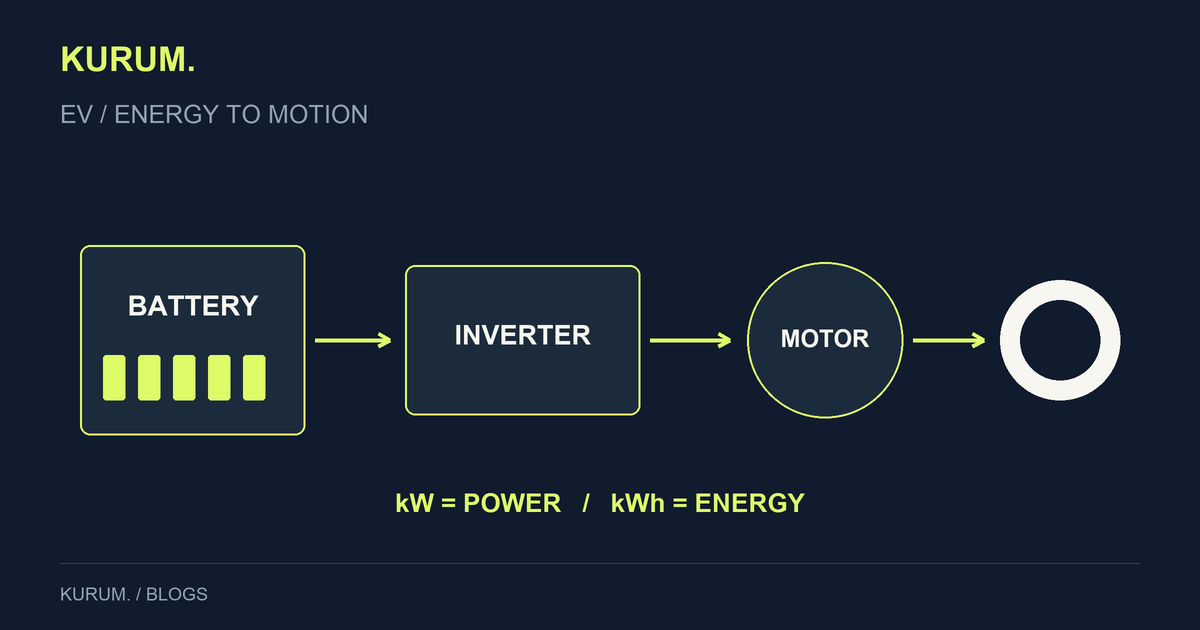
The U.S. Department of Energy separates the traction battery, power electronics, motor and transmission into distinct components. The battery stores energy, controls manage speed and torque, and the motor produces rotation. The auxiliary electrical system serves other vehicle functions. [1]
This is a useful chain of functions rather than a promise that every vehicle has the same number of motors or mechanical layout. A specific model’s documents are needed for its drivetrain, usable battery capacity and charging capabilities. The word electric does not describe one identical technical package.
What is the difference between kW and kWh?
kW measures power; kWh measures energy. Power describes the rate of energy transfer, while energy describes the total amount. Battery capacity, motor power and charging power therefore require different units. Identical-looking numbers are not interchangeable when their units differ.
For a purely hypothetical calculation, assume 60 kWh of usable energy and average consumption of 20 kWh per 100 kilometres. Simple division gives 300 kilometres. This is not a range claim for an actual car: usable energy and consumption vary with conditions, so a real result need not match the illustration.
How do AC and DC charging differ?
With AC charging, the onboard charger converts incoming alternating current into the direct current needed by the battery. With DC charging that conversion takes place in external equipment. The station’s rated power and the car’s accepted power need not be equal. The vehicle and infrastructure both impose limits. [1][4]
As another hypothetical calculation, adding 30 kWh at an average 10 kW takes three hours if losses are ignored. That is not a charging guarantee. Power can vary, and conversion losses and battery management affect duration. A session’s peak power should not be mistaken for its average throughout.
Why do regeneration and temperature matter?
Some electric motors also generate electricity during deceleration, recovering part of the vehicle’s movement energy. Thermal management helps maintain suitable conditions for the battery, motor and power electronics. An automotive battery system is therefore more than a large standalone cell. [1]
The Department of Energy notes widespread use of lithium-ion batteries in battery-electric vehicles, while chemistry and pack design vary. Two cars with the same stated capacity can differ in weight, operating conditions and energy management. [2]
How should range and environmental claims be read?
Look for the test standard, operating conditions and the definition of usable energy. Comparing trips with different speeds, loads and temperatures as if they were controlled tests can be misleading. Daily suitability also depends on where and how often charging is possible, rather than only the largest range number. [3][4]
A fully electric vehicle has no combustion exhaust at the tailpipe. That is not a claim of zero impact across manufacturing and electricity production. [3] A meaningful technical comparison states its energy source, use pattern and measurement boundary instead of relying on a single slogan.
Frequently asked questions
Are kW and kWh the same?
No. kW measures power; kWh measures energy.
Does regeneration eliminate charging?
No. It recovers some energy during slowing but external energy is still needed.
Will a car always receive a station’s rated power?
No. The vehicle, equipment and battery conditions can limit accepted power.
Sources
Sources checked: 29 October 2026